
The Yoked Rat Problem: What Neuroscience Tells Us About Motivation and Leadership
It’s Saturday morning. You stroll into the kitchen, coffee in hand, ready to reclaim the weekend. Two days to breathe, reset, and recharge.
Then your partner appears. Their warm smile is quickly followed by a cascade of requests — “If you don’t mind…”, “Don’t forget you said you’d fix…”, “Could you just…” The weekend hasn’t even started, and already you feel the energy draining out of you.
Sound familiar? Now consider this: somewhere across town, someone else is deep into a weekend project — building something, creating something, solving something — and they’re energised by every hour of it. They’re working just as hard, maybe harder. So what’s the difference?
The difference is choice. And the science behind it is more powerful than most leaders realise.
The Rat That Changed How We Think About Effort
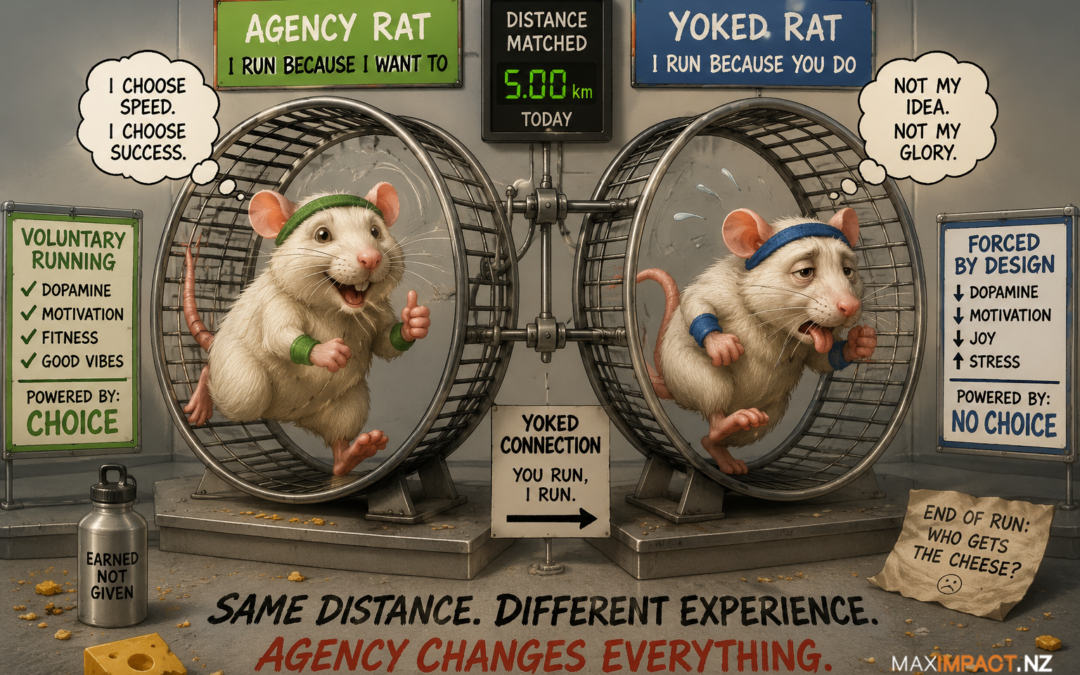
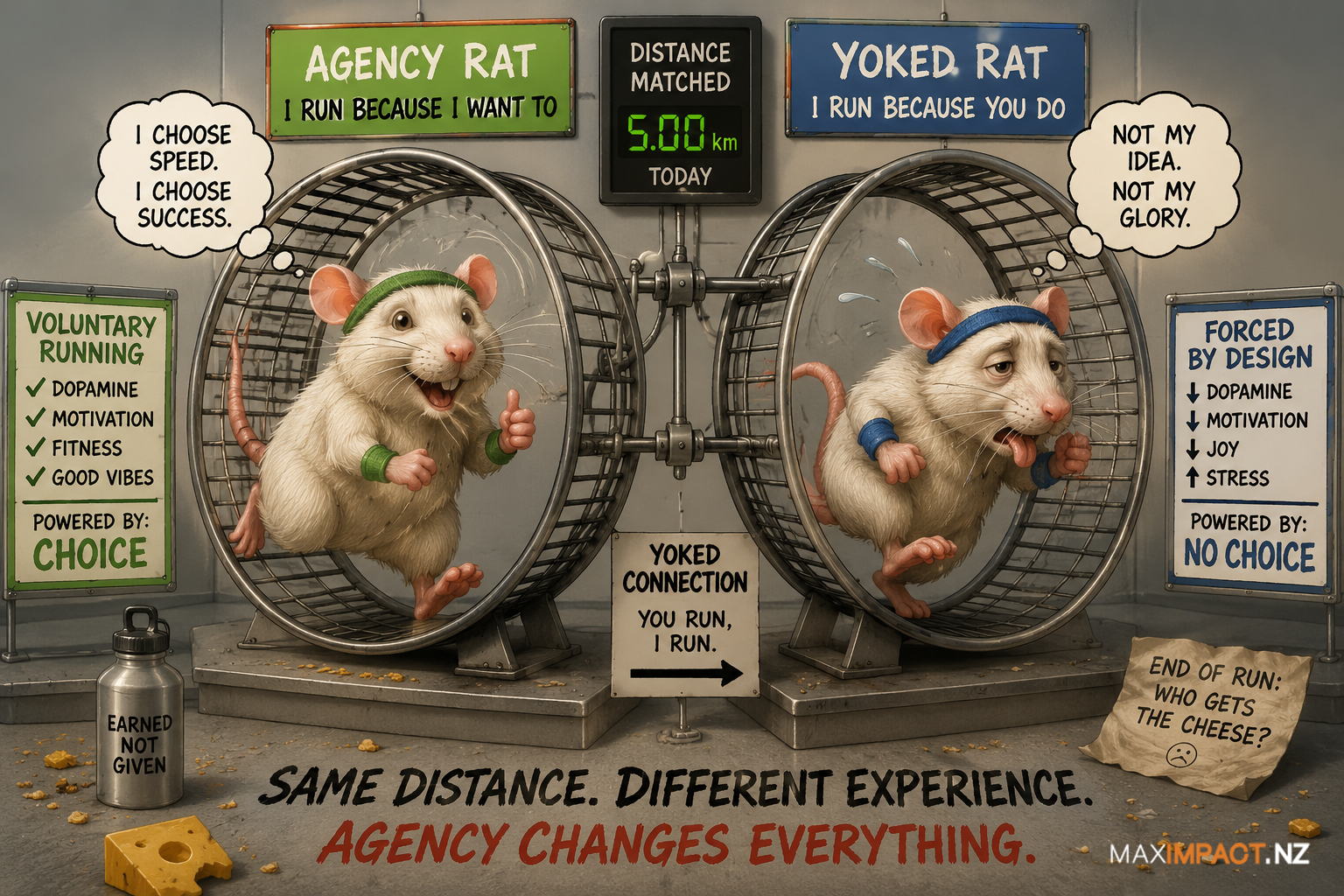
In a landmark series of studies, researchers including Leasure and Jones (2008) ran an elegant experiment. Two groups of rats were paired together on a treadmill. One rat ran voluntarily — it chose when to run and for how long. The other rat, its “yoked” partner, was forced to run the exact same distance at the exact same time, with no say in the matter.
Same exercise. Same duration. Same physical demand.
But the outcomes? Dramatically different.
The voluntary runners showed higher levels of brain-derived neurotrophic factor (BDNF) — a protein crucial for brain health, learning, and resilience. They had lower stress hormone responses. They recovered better. Psychologically, they thrived. The yoked rats, despite doing identical work, showed none of these benefits to the same degree.
The researchers had isolated something profound: it wasn’t the effort that mattered most. It was the agency.
What This Means for the Brain — and for Your Team
The neuroscience is striking. When people feel “My action → My result,” the brain’s dopamine systems engage powerfully. Effort feels meaningful. Progress feels earned. Motivation builds on itself.
But when people feel “Something is being done to me,” those same systems disengage. Motivation and resilience decline — not because the person is weak, but because the brain is responding exactly as it was designed to.
Agency isn’t just a nice leadership principle. It appears to physically alter:
- Stress physiology
- Dopamine signalling
- Motivation and persistence
- Learning and neuroplasticity
This means that two people doing identical work can have entirely different psychological outcomes depending on one variable: whether they felt they chose it.
Short on time?
Jump straight to what matters most for you:
- The Leadership Implication — for managers and team leads
- The Coaching Application — for coaches and mentors
- The Goal-Setting Application — for personal performance
- The Personal Practice — for everyday life
🎧 No Time to Read? Listen Here
1: The Leadership Implication: Don't Create Yoked Employees

Think about the last time you assigned someone a task. Did it sound like this?
“You need to complete this by Friday.”
Or did it sound like this?
“Here’s the outcome we need by Friday. How would you like to approach it?”
The task is identical. The deadline is identical. But the second version introduces agency — and with it, recruits an entirely different level of motivational circuitry.
People are motivated far less by incentives and rewards than most managers assume. What truly drives sustained performance is ownership, autonomy, and self-direction. When people feel that their effort is the cause of their result, rewards become earned rather than passive — and that distinction matters enormously to the brain.
Great leaders don’t create yoked employees. They create voluntary runners.
The Agency Principle
The same effort can produce completely different psychological outcomes depending on one factor: whether we experience it as a choice. Motivation isn’t determined solely by what we do. It is shaped by how much ownership we feel over doing it.
- Agency transforms effort into energy.
- Control transforms effort into compliance.
- I actually like ending the box with a memorable equation:
|
Effort + Choice = Motivation Effort – Choice = Compliance |
Great leaders don't create yoked employees.
They create voluntary runners
2: The Coaching Application: Three Shifts That Change Everything

If you lead, coach, or develop people, the agency principle offers a simple but powerful framework.
A: Let People Choose The Goal Whenever Possible.
-
- Even when the destination is fixed, involving people in defining the goal increases buy-in dramatically. Ask: “What would success look like to you?”
B: Let People Choose The Method.
-
- Prescribing the “how” creates yoked runners. Defining the “what” and trusting people with the “how” creates voluntary ones. Autonomy over method is often more motivating than autonomy over the goal itself.
C: Let People Choose And Track Their Own Progress.
-
- Self-monitoring is itself an act of agency. When people track their own results, they own both the effort and the outcome — which is precisely the neurological loop that sustains motivation.
Even small amounts of choice dramatically increase commitment. You don’t need to hand over the wheel entirely. You just need to stop controlling every turn.
3: The Goal-Setting Application: Same Behaviour, Different Brain

Consider these two framings of identical behaviour:
- “Exercise five times per week because the coach said so.”
- “I choose to exercise five times per week because I want more energy.”
Same action. Same frequency. But the second framing activates agency — and with it, a completely different motivational system. The research suggests this isn’t just a psychological trick. It’s a neurological reality.
When you reframe goals from assigned to chosen, you shift from compliance to commitment. And commitment is what sustains behaviour when motivation dips, when life gets busy, and when the results don’t come as quickly as expected.
4: A Personal Practice: The "I Choose To" List

Several years ago, I stopped writing a To Do list.
Instead, I started writing what I call my “I Choose To” list.
It sounds like a small change. It isn’t. This simple reframe does three things:
- Choice — It challenges me daily to decide how I want to live, rather than simply reacting to what demands my attention.
- Why — Rather than just doing a task, I consider why I’m doing it. Purpose transforms obligation into intention.
- Others — It invites me to consider how my actions might be a gift to someone else. Service chosen freely feels different from service extracted.
You cannot dodge the obligations of life. But you can prevent them from being draining — by claiming your agency over them, even when the task itself is non-negotiable.
Try This Exercise: The Agency Audit
Think about one task you’ve been putting off this week. Now answer these three questions:
-
-
- Why am I doing this?
- Who ultimately benefits?
- What part of this task can I choose?
-
Now rewrite the task beginning with:
I choose to…
Notice whether your motivation shifts.
The Bottom Line
The yoked rats ran the same distance. They put in the same effort. But they didn’t get the same result — because they weren’t running by choice.
Your team is no different. Your clients are no different. You are no different.
When you design experiences — whether for your employees, your coaching clients, or yourself — that build in genuine agency and choice, you’re not just being a nice leader. You’re working with the brain’s deepest motivational architecture rather than against it.
The question worth sitting with today:
Where in your leadership, your coaching, or your own goal pursuit are you creating yoked runners — when you could be creating voluntary ones?
Reflection
Personal Reflection
Where in your life have you quietly become a yoked runner?
Leadership Reflection
Where are you solving problems for people instead of giving them ownership over the solution?
Summary Takeaways
- Motivation grows when people experience agency.
- Ownership is more powerful than control.
- Choice changes how the brain experiences effort.
- Great coaching creates ownership—not dependency.
- Great leadership creates voluntary runners—not yoked ones.
Aiden Holliday combines neuroscience, leadership, and lived experience to unlock human potential. With international speaking, corporate strategy facilitation, executive coaching and a designer of national qualifications under his belt, his Neuro Nuggets distill science into everyday leadership wisdom that sticks—and works. Aiden holds a MSc in Neuroscience & Psychology, M. Phil. (Ldrshp) and an MBA in International Strategy.
Research Referenced in this Article
The research referenced in this article draws on work by Leasure & Jones (2008), “Forced and voluntary exercise differentially affect brain and behavior,” and Zheng Ke et al., “Effects of Voluntary, Involuntary, and Forced Exercises on Brain-Derived Neurotrophic Factor and Motor Function Recovery.”